
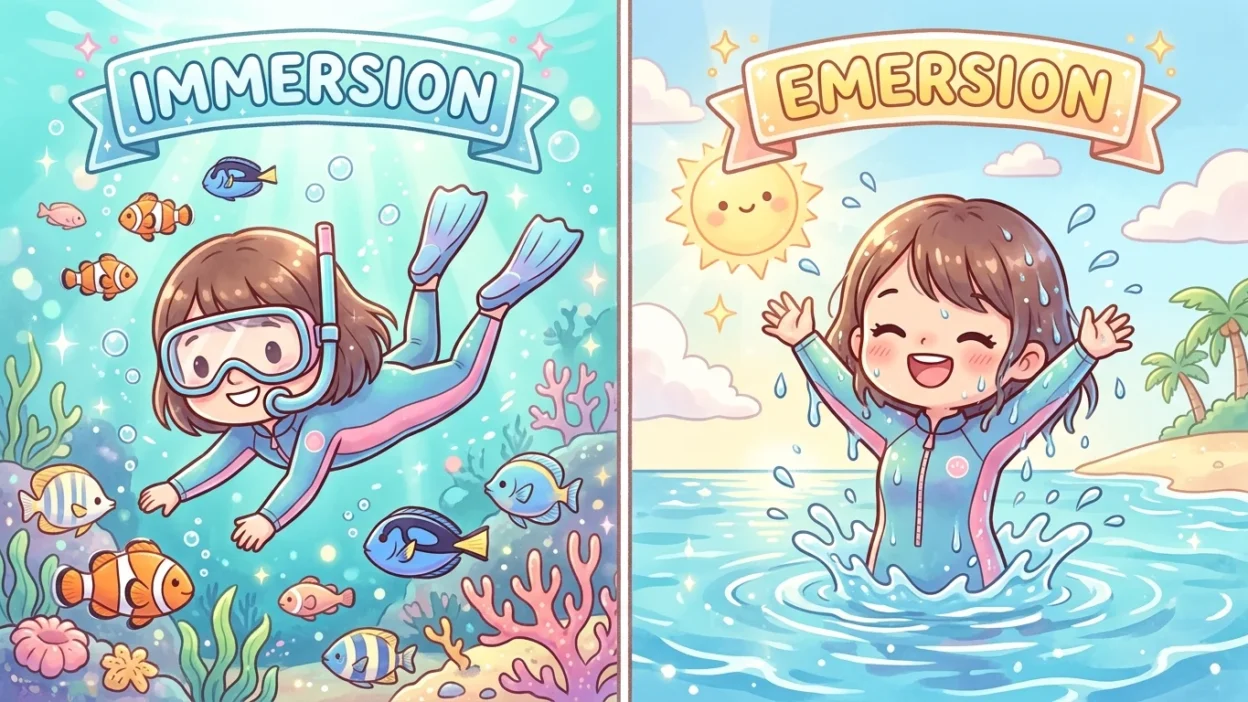
If you’ve ever stopped mid-writing to wonder whether emersion or immersion is the right word, you’re definitely not alone. These two terms look similar and even sound related, but they describe completely opposite actions—and using the wrong one can quietly change your meaning.
So let’s make this simple and clear. By the end of this guide, you’ll not only understand emersion vs immersion, but you’ll also feel confident using them correctly in real-life writing and conversations.
Quick Answer
- Immersion means going into something or being fully surrounded or deeply involved.
- Emersion means coming out of something, especially rising out of water.
Easy memory tip:
Immersion = IN
Emersion = EXIT
What Does Immersion Mean?
Immersion describes the act of being completely surrounded or deeply involved in something. It can be physical, mental, or emotional.
You’ll see it used a lot in everyday situations because it applies to experiences we all relate to.
Common Contexts of Immersion
- Learning a new language
- Watching movies or gaming
- Traveling and experiencing culture
- Deep focus or concentration
Examples of Immersion
- She learned Spanish through full immersion in Mexico.
- The game creates a strong sense of immersion.
- He was in complete immersion while reading the novel.
In simple terms, immersion is about being fully inside an experience.
What Does Emersion Mean?
Emersion is the opposite—it refers to the act of emerging or coming out of something, usually from water.
It’s not commonly used in everyday speech, but you’ll often find it in scientific or descriptive writing.
Common Contexts of Emersion
- Marine life behavior
- Environmental studies
- Natural processes
Examples of Emersion
- The diver’s emersion signaled the end of the dive.
- The turtle’s emersion was brief before it returned underwater.
- Emersion of land occurs when water levels drop.
Think of emersion as the moment something reappears or surfaces.
Emersion vs Immersion: Side-by-Side Comparison
Here’s a quick visual breakdown to lock it in:
| Feature | Immersion | Emersion |
|---|---|---|
| Meaning | Going into / being surrounded | Coming out / emerging |
| Direction | Inward | Outward |
| Usage | Very common | Rare |
| Context | Daily life, learning, media | Scientific, environmental |
| Example | Immersion in water | Emersion from water |
Common Mistakes to Avoid
Even experienced writers mix these up sometimes. Let’s fix that.
Using Emersion Instead of Immersion
❌ Language emersion programs help learners
✔️ Language immersion programs help learners
Treating Them as Synonyms
They are not interchangeable. They describe opposite directions.
Overusing Emersion
In casual writing, “emersion” can feel too technical. “Emerging” or “coming out” often sounds more natural.
Forgetting Direction
Always check:
- Going in → Immersion
- Coming out → Emersion
Real-Life Examples That Make It Click
Let’s bring this into everyday life so it sticks easily:
- Watching your favorite show without distractions → Immersion
- A dolphin jumping out of the ocean → Emersion
- Learning a culture by living in it → Immersion
- A submarine rising to the surface → Emersion
Once you picture movement, the difference becomes obvious.
American vs British English
There’s no real difference between American and British English for these words.
- Both use immersion widely in daily language
- Both treat emersion as a rare, technical term
- Spelling stays exactly the same in both versions
So you can use them confidently no matter your audience.
Related Words and Synonyms
Words Similar to Immersion
- Engagement
- Absorption
- Involvement
- Deep focus
Words Similar to Emersion
- Emergence
- Surfacing
- Rising
- Appearance
These alternatives can help you vary your writing naturally.
When Should You Use Each Word?
Here’s a simple rule you can rely on:
Use immersion when talking about:
- Experiences
- Learning
- Entertainment
- Focus
Use emersion when talking about:
- Physical movement out of water
- Scientific or natural descriptions
If you’re unsure, immersion is usually the correct choice in everyday writing.
FAQs
1. Is emersion a real word?
Yes, it’s a valid word, but it’s mostly used in scientific or technical contexts.
2. Why is immersion more common?
Because it applies to daily experiences like learning, entertainment, and focus.
3. Can I use emersion casually?
You can, but it may sound too formal. Simpler phrases often work better.
4. Are immersion and submersion the same?
Not exactly. Submersion is physical, while immersion can also be mental or emotional.
5. What’s the easiest way to remember the difference?
Immersion = IN, Emersion = EXIT.
6. Is immersion used in education?
Yes, especially in language learning programs.
7. Can immersion be emotional?
Absolutely. You can be immersed in feelings, stories, or work.
8. Which word should I use most often?
In most cases, immersion is the better and more natural choice.
Final Thoughts
Understanding emersion vs immersion really comes down to direction. Immersion pulls you into an experience—it’s about depth, focus, and being surrounded. Emersion brings you out—it’s about rising, surfacing, and appearing again.
Once you see them as opposites, the confusion disappears. And honestly, most of the time, you’ll naturally reach for immersion in everyday writing.

Lucas Liam is a skilled writer with a passion for research based and reader friendly content. His work covers multiple topics, including technology and self improvement. Lucas is a valued author at NickHubs.com, delivering clear and helpful articles.