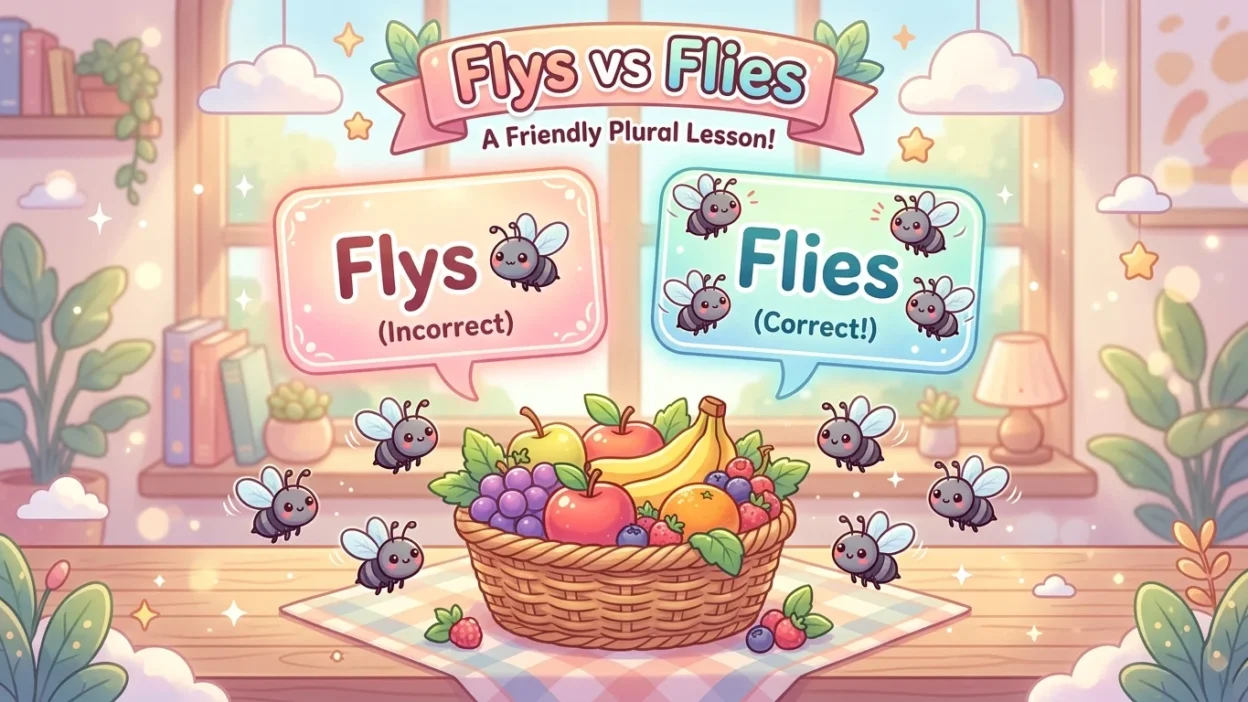
Many people get confused between flys and flies because both spellings seem possible at first glance.
However, only one form is correct when talking about the plural of fly or the verb meaning moving through the air.
If you’ve ever paused while typing these words, don’t worry. The spelling rule is actually simple once you understand how English changes words ending in “y.”
Quick Answer
- Flies is usually the correct spelling.
- Flys is incorrect in most situations.
Use flies when referring to:
- More than one fly
- Someone or something flying
What Does Flies Mean?
Flies can work as both:
- The plural form of fly
- A verb form of fly
Common Uses of Flies
- Insects
- Air travel
- Birds moving through the sky
- Sports references
Examples of Flies
- Flies were buzzing around the kitchen.
- She flies to London every summer.
- The bird flies over the lake every morning.
In modern English, flies is the standard and correct spelling.
Is Flys a Real Word?
Generally, flys is considered incorrect in standard English grammar. Most of the time, people use it by mistake instead of flies.
Incorrect Examples
❌ The bird flys south in winter.
✔️ The bird flies south in winter.
❌ There are many flys near the trash.
✔️ There are many flies near the trash.
Using flys in professional or academic writing can make your work look grammatically incorrect.
Flys vs Flies: Key Differences
| Feature | Flies | Flys |
|---|---|---|
| Spelling | Correct | Usually incorrect |
| Meaning | Plural or verb form of fly | Rare misspelling |
| Usage | Standard English | Avoid in normal writing |
| Recommendation | Always use | Avoid completely |
Why Does Fly Become Flies?
This happens because of a common English spelling rule.
When a word ends with:
- consonant + y
the “y” usually changes to “i” before adding “-es.”
Examples
- Fly → Flies
- Baby → Babies
- City → Cities
- Lady → Ladies
That’s why the correct spelling becomes flies, not flys.
Common Mistakes to Avoid
Forgetting the “I”
❌ Flys
✔️ Flies
This is the most common error.
Ignoring the Y-to-I Rule
Many English nouns and verbs follow this exact pattern.
Typing Too Quickly
Fast texting or typing often causes spelling shortcuts.
Real-Life Examples of Flies
Here are some natural examples:
- The airplane flies smoothly through the clouds.
- Flies gathered near the fruit basket.
- Time flies when you’re having fun.
- The superhero flies across the city.
You’ll notice that flies sounds natural and correct in every sentence.
American vs British English
There is no spelling difference between American and British English.
- American English → flies
- British English → flies
Both versions use the same spelling and grammar rules.
Related Words and Similar Forms
Here are other forms of the word fly:
- Fly
- Flies
- Flying
- Flew
- Flown
These forms are all commonly used in everyday English.
When Should You Use Flies?
Use flies when describing:
- Multiple insects
- Flying movement
- Air travel
- Birds or airplanes in motion
It works naturally in both formal and casual writing.
FAQs
1. Is flys ever correct?
In standard English, flys is usually incorrect.
2. Why is flies spelled with “ies”?
Because words ending in consonant + “y” usually change “y” to “i” before adding “-es.”
3. Is flies used in British English?
Yes, it is correct in both British and American English.
4. Can flys appear in dictionaries?
Sometimes as a rare surname or special term, but not as the normal plural or verb form.
5. Is flies a verb or noun?
It can be both depending on the sentence.
6. What is the easiest way to remember the spelling?
Think of similar words like babies and cities that also change “y” to “ies.”
7. Is flies used in formal writing?
Yes, it is fully correct in all types of writing.
Final Thoughts
Now you clearly understand that “flies” is the correct spelling, while “flys” is usually just a common spelling mistake. Because of this simple grammar rule, you can avoid confusion and write more accurately.
As you continue practicing, you will naturally remember to change the “y” to “ies” in the correct situations. So, instead of guessing, you’ll confidently use the proper spelling every time.

Leo Meteo is a versatile blogger who writes about lifestyle, trends, and wellness topics. He enjoys creating content that is informative, relatable, and engaging for readers. Leo actively contributes articles to NickHubs.com, helping grow its content library.