
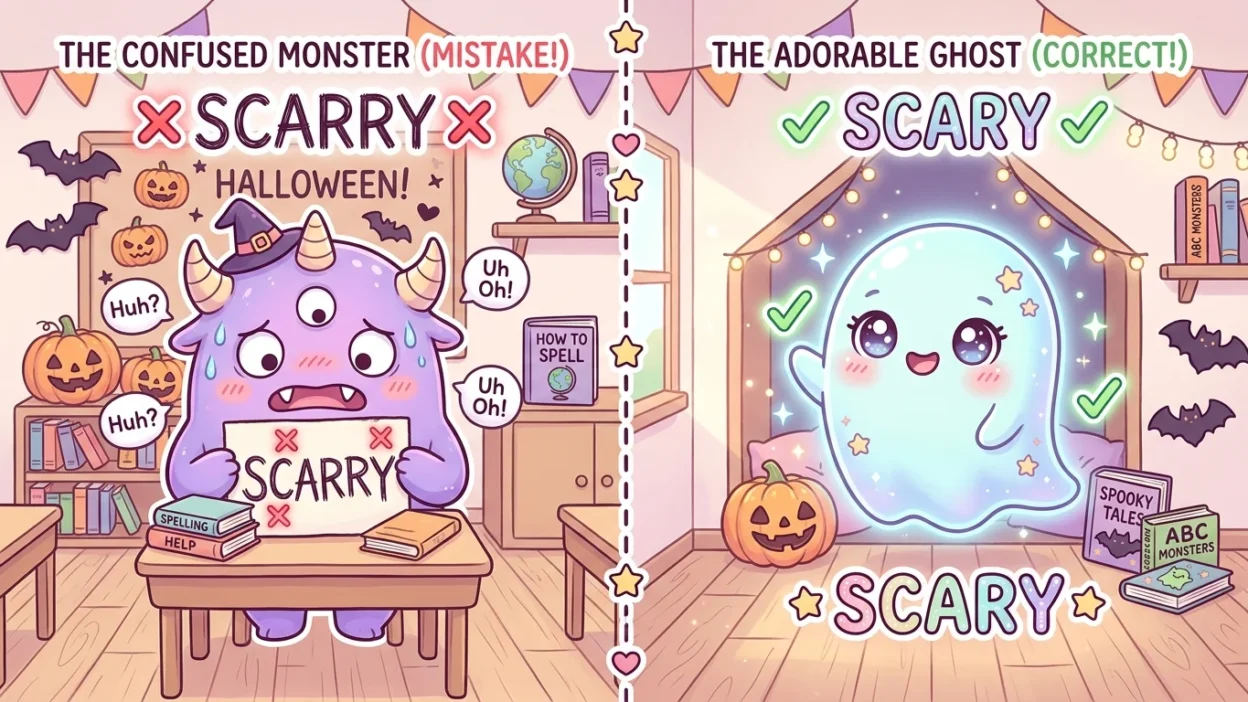
Many people get confused between scary and scarry because both words sound almost the same when spoken quickly.
However, only one spelling is correct in standard English, while the other is simply a common mistake.
If you’ve ever hesitated before typing the word, don’t worry. Once you understand the spelling rule and see a few examples, remembering the correct form becomes much easier.
Quick Answer
- Scary is the correct spelling.
- Scarry is incorrect in modern English.
Whenever you want to describe something frightening, creepy, or alarming, always use scary.
What Does Scary Mean?
Scary is an adjective used to describe something that causes fear or feels frightening.
Common Uses of Scary
- Horror movies
- Haunted houses
- Nightmares
- Dangerous situations
Examples of Scary
- That movie was really scary.
- The storm looked scary last night.
- She told a scary ghost story.
In all types of English writing, scary is the accepted and correct spelling.
Is Scarry a Real Word?
No, scarry is not considered a correct English word. It usually appears because people accidentally add an extra “r” while spelling.
Incorrect Examples
❌ That was a scarry experience.
✔️ That was a scary experience.
❌ I watched a scarry movie yesterday.
✔️ I watched a scary movie yesterday.
Using scarry in formal writing can make your work look unpolished or grammatically incorrect.
Scary vs Scarry: Key Differences
| Feature | Scary | Scarry |
|---|---|---|
| Spelling | Correct | Incorrect |
| Meaning | Frightening or creepy | No accepted meaning |
| Usage | Standard English | Spelling mistake |
| Recommendation | Always use | Avoid completely |
Why Do People Misspell Scary?
The confusion usually happens because many English words double consonants, so some writers assume scary should also have two “r” letters.
However, the word comes from:
- Scare → Scary
When adding “-y,” the spelling does not require doubling the “r.”
Similar Examples
- Hairy
- Wary
- Cheery
Not every English word doubles its consonants, which is why spelling mistakes like scarry happen so often.
Common Mistakes to Avoid
Adding an Extra “R”
❌ Scarry
✔️ Scary
This is the biggest mistake people make.
Typing Too Fast
Quick texting or casual typing often leads to extra letters.
Assuming Pronunciation Changes Spelling
Even though the word sounds strong when spoken, the spelling remains simple: scary.
Real-Life Examples of Scary
Here are some natural examples:
- The abandoned house looked scary at night.
- My little brother hates scary stories.
- That roller coaster was exciting but scary.
- The thunder sounded scary during the storm.
You’ll notice that scary fits naturally in every sentence.
American vs British English
There is no spelling difference between American and British English.
- American English → scary
- British English → scary
Both versions use the exact same spelling.
Related Words and Synonyms
Here are a few similar words you can also use:
- Frightening
- Creepy
- Terrifying
- Spooky
- Chilling
These words can help make your writing more expressive and varied.
When Should You Use Scary?
Use scary when describing:
- Horror movies
- Dangerous moments
- Creepy places
- Frightening experiences
It works naturally in both casual and formal writing.
FAQs
1. Is scarry ever correct?
No, scarry is not a correct English spelling.
2. Why do people write scarry?
Usually because they mistakenly think the word needs a double “r.”
3. Which spelling should I always use?
You should always use scary.
4. Is scary used in British English?
Yes, it is correct in both British and American English.
5. Can scarry appear in dictionaries?
Generally only as a misspelling reference, not as a proper word.
6. Is scary an adjective?
Yes, it describes something frightening or fear-inducing.
7. What is the easiest way to remember the spelling?
Think of the base word scare. Since scare has one “r,” scary also keeps one “r.”
Final Thoughts
Now you clearly understand that “scary” is the correct spelling, while “scarry” is simply a common spelling mistake. Because of this easy spelling rule, you can avoid confusion and write more accurately.
As you continue practicing, you will naturally remember the correct form in every situation. So, instead of second-guessing, you’ll confidently use the right spelling every time.